Context
Mercury Insights create a new way to understand your company’s financial health in real time. It was designed as a place where founders actively work with their financial data, not just glance at it.
This project was born from a consistent pattern in customer feedback: founders had access to mountains of transaction data but lacked the tools to extract meaning from it. Core questions — runway, spend allocation, financial optimization — were going unanswered. That gap became the product's north star.
Role
I led design across the mobile experience, covering everything from MVP concepts and user research to translating web features for mobile and working closely with engineers to implement the auto-categorization logic in-app. With web and mobile shipping in tandem, there was a large surface area to design quickly and thoughtfully.
Problem
Business accounts, and some personal accounts, generate an overwhelming volume of transactions — but raw data without structure is meaningless.
Two problems needed to be solved: how to automatically and accurately categorize every transaction, and how to determine which insights are actually worth surfacing to founders. One is a data quality problem, the other is a prioritization problem. Solving both was the prerequisite to building anything useful.
Foundational work
Great insights start with clean data. In late 2024, Mercury acquired Teal — an accounting-focused startup — and we collaborated with their team to integrate Teal's auto-categorization logic directly into Mercury's backend.
Approach
Mercury Insights was built by a cross-functional team spanning design, product, and engineering, with a group of finance experts and controllers brought in early to shape the product alongside us. The team met weekly — sharing designs, running crits, and putting prototypes in front of real founders throughout the process.
Mobile users are often on-the-go, but that was never a reason to simplify the information — just to present it better. My focus areas for the mobile experience were:
Timeframes
Treating date range control and visualization as the most important element.
Smart recaps
Contextual summaries that reflect the specific data a founder is honing in on.
Data transparency
Establishing clear data data sources to build trust in what users are seeing.
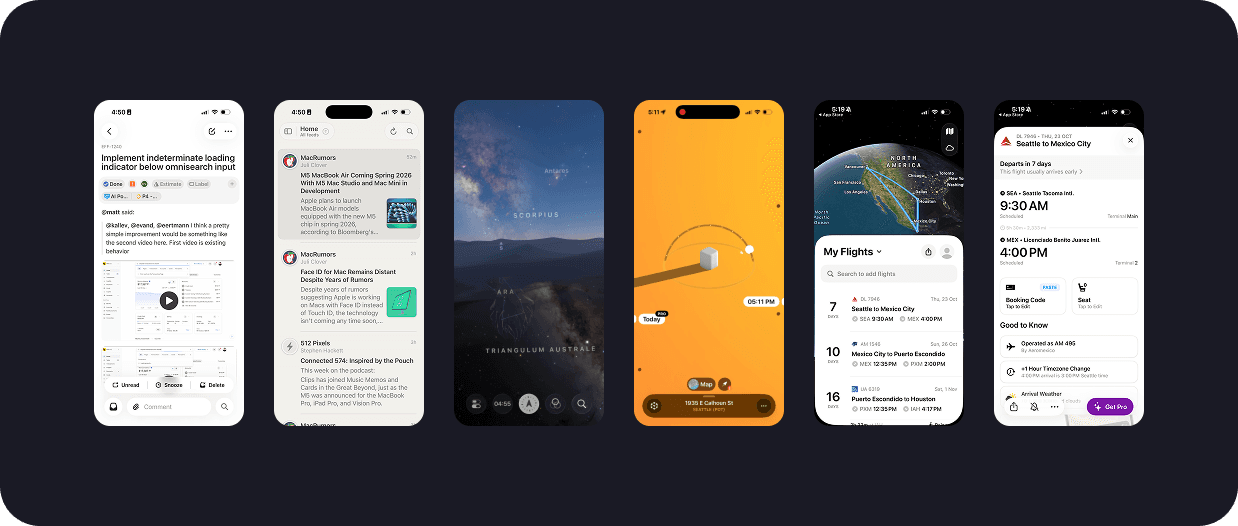
I gathered inspiration from apps that pack a high density of information into a small space without feeling overwhelming
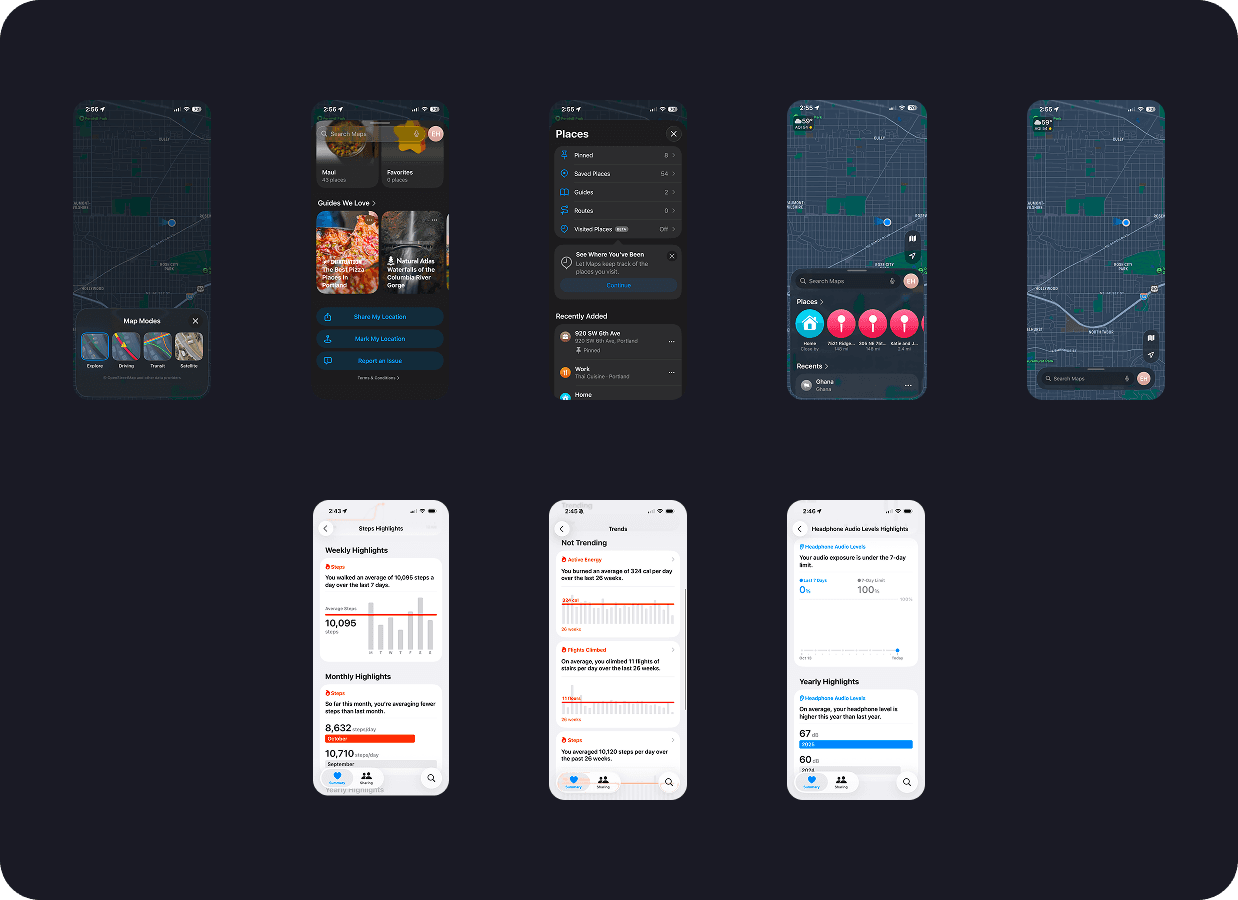
The central design question was whether the chart itself should serve as the canvas — with controls and context layered on top — and if so, how summaries and recaps could emerge naturally from it.
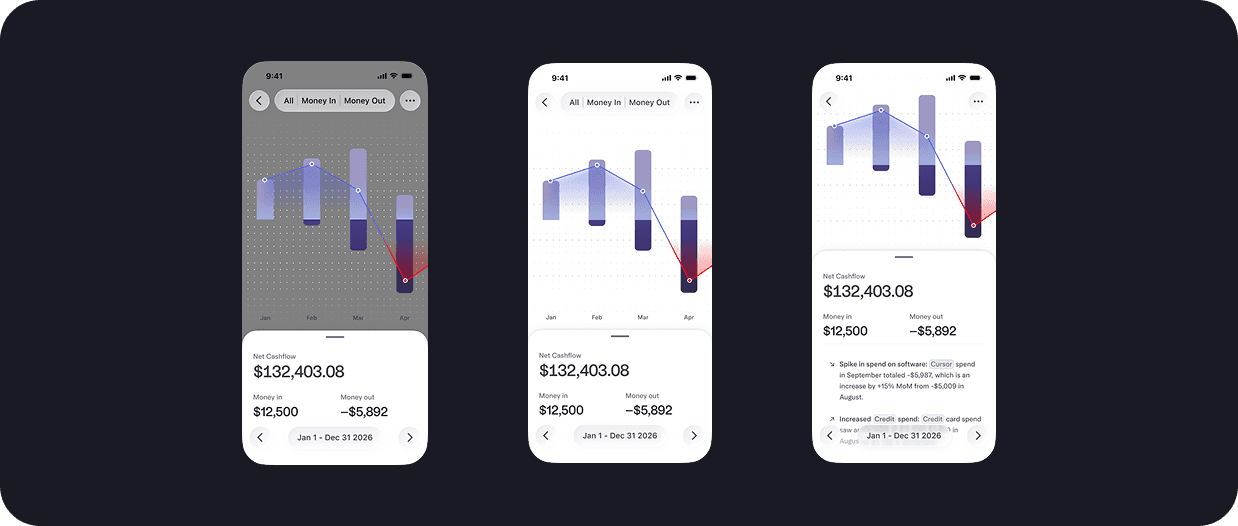
Early concepts led with data visualization, positioning the timeframe control as the primary interaction and letting AI-generated recaps surface naturally beneath the chart.
Solution
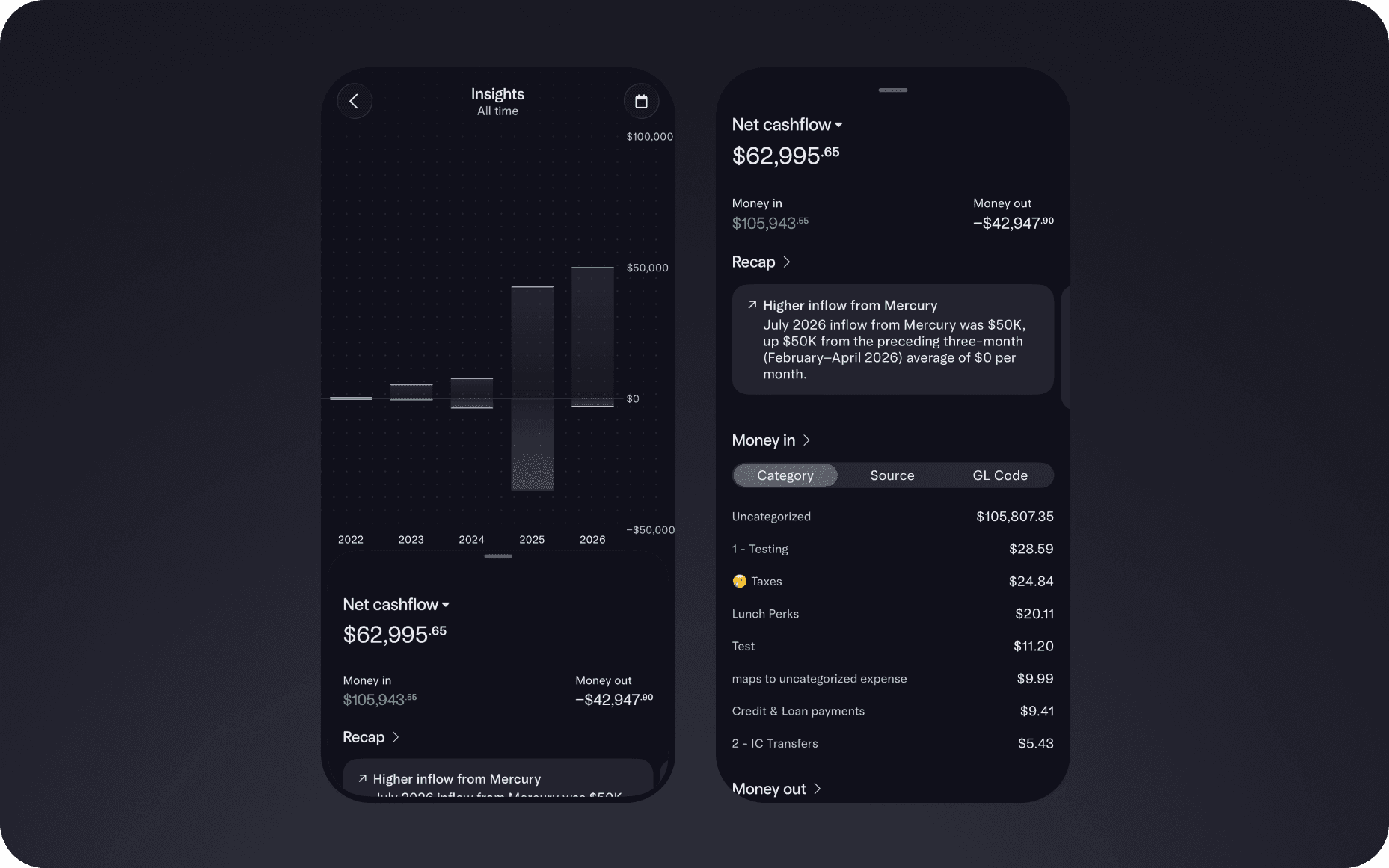
After several iterations, I rethought the relationship between the chart and the recap summaries. Founders care most about net cashflow and money in and out — so that information was surfaced front and center. The chart was scaled down to naturally reveal the recaps below, with a visible y-axis added to give the numbers proper context. A detail absent in earlier versions, but one that made the difference between data that informed and data that confused.

Users can interact with the timeframe
Insights live on the home screen as well and generate automatically. No manual effort required. AI analyses inflow, outflow, and spend trends.
Users can dial in their own cashflow parameters, with everything below updating to reflect it. Related transactions are surfaced transparently beneath each recap — for those who want to go deeper.